

Republicans and Democrats rarely see eye to eye anymore, but there’s growing agreement on one uncomfortable reality: Social Security is in serious trouble. A recent Washington Post report that spread quickly online described a system “ending the year in turmoil,” and the details are hard to ignore as the country heads toward 2026.
The agency is overwhelmed by a multimillion-case backlog. Field offices are struggling under record transaction volumes. Customer service has deteriorated so badly that callers now wait more than an hour, on average, just to get a callback.
“It wasn’t great before, don’t get me wrong,” claims specialist John Pfannenstein said in the report. “But now the cracks are really starting to show.”
Some of the disorder may be linked to recent efficiency-driven reforms under President Donald Trump, but the truth is that Social Security’s problems run far deeper than delayed calls or paperwork piles. Those frustrations are minor compared to the program’s looming financial crisis—a projected $25 trillion shortfall over the next 75 years.
According to the Bipartisan Policy Center, Social Security’s main trust fund is on track to run dry by 2033. Lawmakers on both sides have known for decades that the system’s finances are unsustainable, yet meaningful reform has been repeatedly postponed.
Blaming any single president may score political points, but it misses the larger picture. Social Security hasn’t seen major reform since 1983. There were attempts. In the late 1990s, President Bill Clinton explored a system inspired by Chile’s individual accounts, but the effort collapsed amid impeachment drama. Years later, President George W. Bush pushed for reform on a national tour, only to see the proposal sink under partisan resistance.
That failure came at a cost. Economist Andrew Biggs later noted that Bush’s plan could have delayed insolvency by roughly a decade, cut long-term funding gaps by about one-third, and preserved benefits for retirees who rely on the program most. Instead, the opportunity slipped away. Today, nearly everyone agrees the system is broken—even if no one agrees on how to fix it.
The 401(k) Contrast: Ownership Over Promises
This dysfunction stands in sharp contrast to America’s other major retirement pillar: the 401(k). Unlike Social Security, 401(k)s are not government entitlements. They are privately owned, tax-advantaged accounts managed by individuals, employers, and financial advisers. Retirement outcomes depend on contributions and long-term investment decisions, not political assurances.
For years, critics warned that 401(k)s shifted too much responsibility onto workers and exposed their futures to the stock market, which was often portrayed as confusing or risky. Yet those fears haven’t materialized the way many predicted.
Instead, 401(k)s are flourishing. A Wall Street Journal report recently highlighted how these plans are “minting a new generation of modest millionaires.” Firms like Fidelity, T. Rowe Price, and Alight are reporting record numbers of account holders with balances exceeding $1 million. At Alight alone, the share of clients crossing that threshold doubled in just three years—from 1.3 percent in 2022 to 2.6 percent by the third quarter of 2025. Other firms are seeing even higher figures.
Skeptics point out that millionaires still represent a minority of participants. That’s true—but those statistics also include younger workers and newer contributors who are only beginning to benefit from decades of compounding growth.
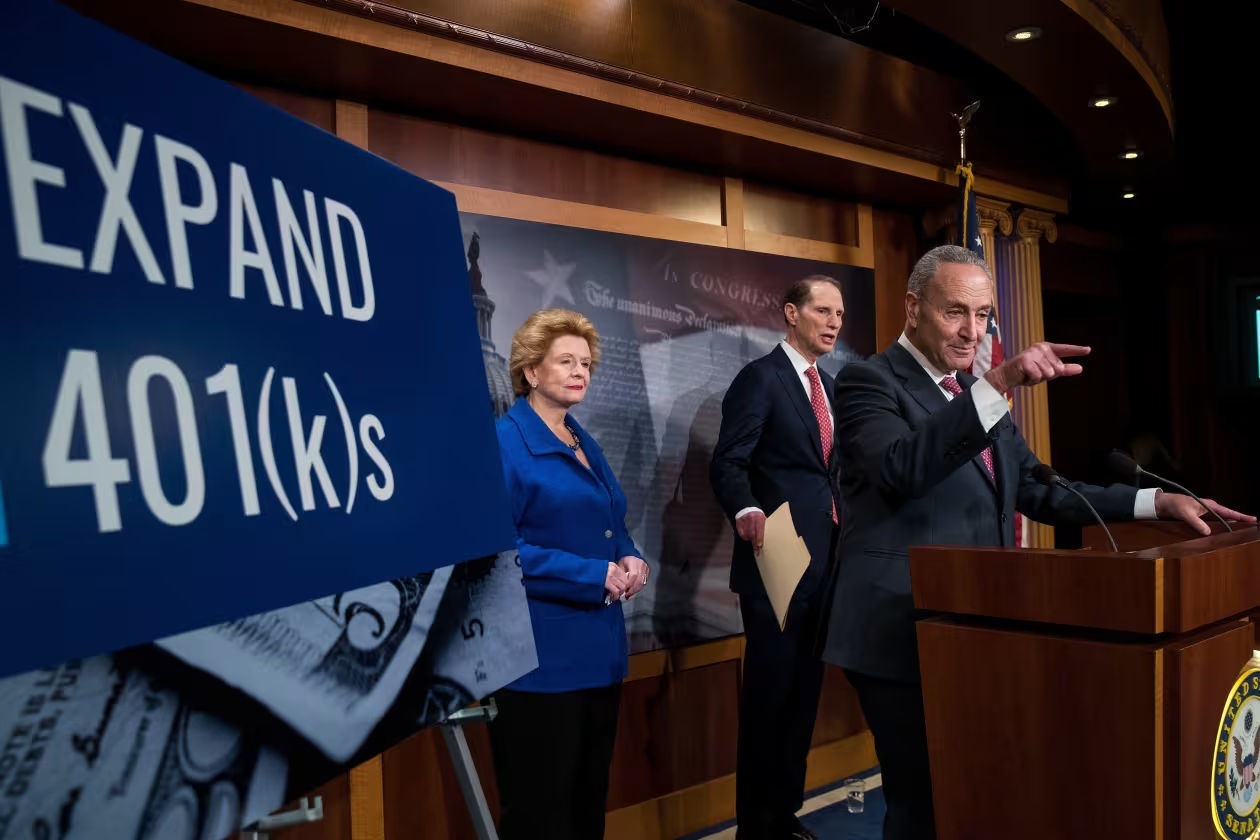
What’s increasingly clear is that 401(k)s have become a more effective retirement tool than Social Security. For the first time, more than half of private-sector workers now rely on them, according to the Wall Street Journal.
The numbers help explain why. One Tax Foundation analysis found that a worker who invested the equivalent of the payroll tax into a 401(k)-style account could accumulate about $719,670 by retirement. Converted into annual income, that nest egg could produce roughly $57,319 a year. The expected Social Security benefit for the same worker? About $19,646.
Critics often argue that these projections assume steady market returns. Historically, stocks have averaged around 10 percent over the long term, crashes included. What’s less often acknowledged is that Social Security also rests on an assumption—that it remains solvent. Even then, its expected return is closer to 4 percent.
In the end, the difference comes down to structure. One system is built on individual ownership and long-term investment. The other depends on political promises and a shrinking workforce supporting an aging population. That’s why 401(k) Balances Are Creating Record Millionaires as Social Security Falters—and why Americans are likely to keep relying on personal savings long after the government program reaches its breaking point.