
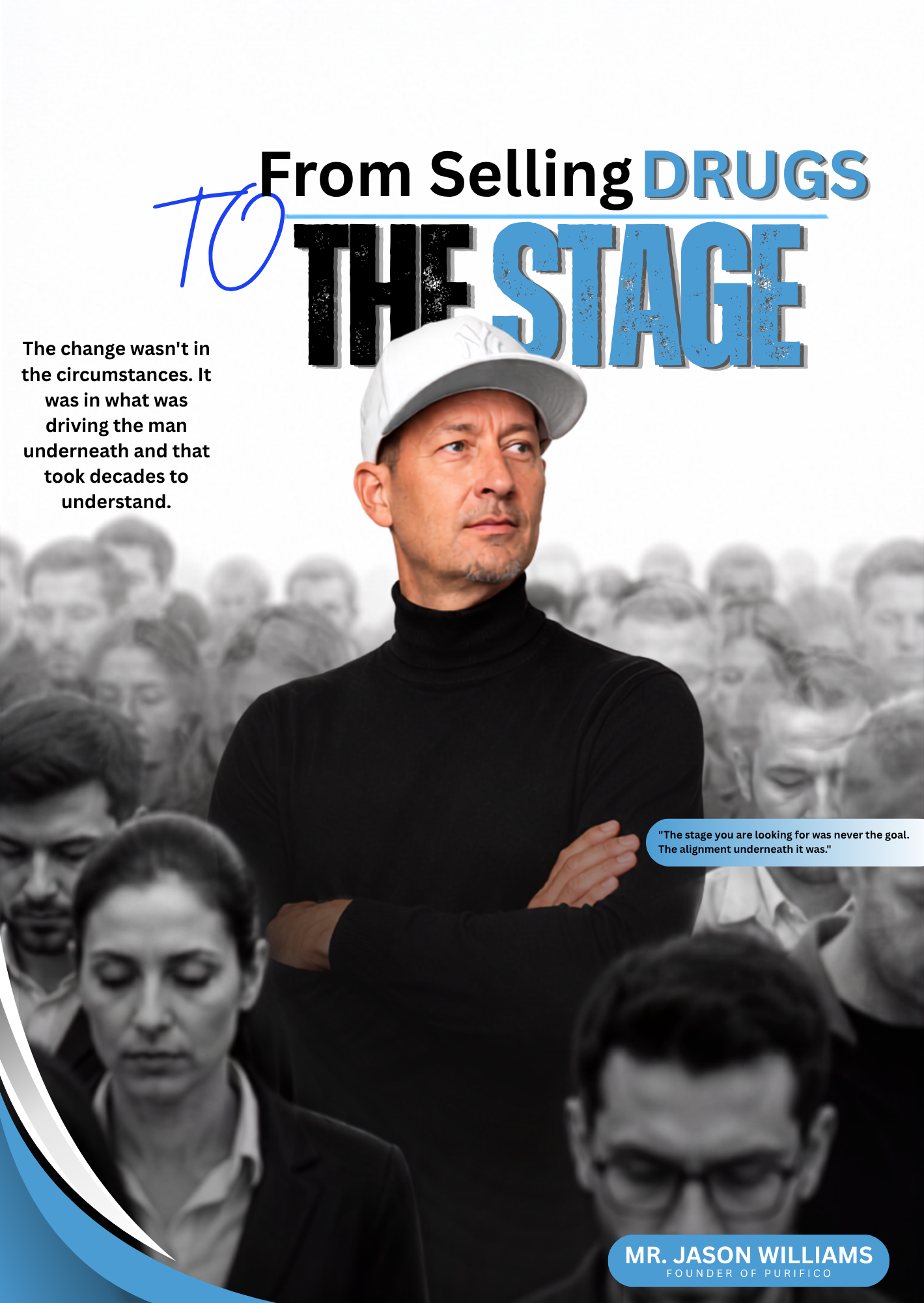
There is a version of this story that would be easy to tell. A young man grows up in a hard environment, makes some poor choices, finds faith, turns his life around, and goes on to help others. It is a familiar shape, and it is not wrong, but it is incomplete. It leaves out the part that actually matters, which is not the change in circumstances. It is the change in what was driving the man underneath those circumstances.
I was fifteen years old when I was, by any honest definition, a drug dealer. Not someone experimenting on the margins of that life, but fully in it. I was making money, building a reputation, and moving through my world with a kind of confidence that felt, at the time, like I had finally figured something out. I want to be precise about why, because the reason matters more than the fact itself.
I grew up watching my parents work long hours for very little in return. I watched people who did things the right way struggle to get ahead, while people with control over their circumstances got what they wanted. I wanted things that felt, at fifteen, like basic dignity: the right shoes, the ability to go where my friends went without explaining why I could not. In certain communities, the path to that kind of self-sufficiency runs directly through the underground economy, and mine was no exception. I was not simply choosing an activity. Without realizing it, I was forming the values that would shape the next chapter of my life: performance, image, control, results. Not one of those values was rooted in anything that could actually hold.
That is the part most retellings of a comeback story skip past. The point is never really the specific behavior. The point is what the behavior was standing in for.
The Identity Underneath the Identity
By that point in my life, I already had one identity built around basketball, which had given me real opportunity, including a spot at one of the most competitive high school programs in the country. Basketball gave me approval. It connected me to coaches, to teammates, to my father in the one place our relationship still functioned. But once I had tasted what it felt like to build an identity around performance and recognition, that pattern did not stay contained to a basketball court. It expanded into the streets, where I found something basketball could not give me: a sense of internal control. Basketball was about being seen. The streets were about feeling powerful regardless of who was watching. Control, I learned, is addictive, especially when the rest of your life feels unpredictable. It gave me a sense of security that was both completely real in the moment and entirely false in the long run.
Eventually, what I was doing in the dark became visible, as it always does. My parents found out, and the version of my life that had been built around that identity collapsed almost overnight. I do not tell that part of the story for shock value. I tell it because the collapse is
not actually where the transformation happened. The collapse only revealed what had already been true the entire time: I had built an identity on something that could not hold weight.
What Speaking on Stages Actually Required
Years later, I would find myself speaking on platforms I never could have imagined as a teenager, running in circles with people who had genuine influence, building organizations focused on the very thing my own adolescence had lacked: real, holistic support for young people trying to find their way. From a distance, that looks like a clean redemption arc. Drug dealer becomes author, podcaster, coach, youth development strategist. And it is true. But the part that took decades to understand is that the stage itself was never the proof of change. Plenty of people reach a stage while still being driven by the exact same hunger for performance, image, and control that drove them at fifteen. The platform changes. The engine underneath it does not have to.
What actually changed for me was not my circumstances. It was the thing I was building my identity from in the first place. For most of my life I had been driven by values I inherited or absorbed without ever examining them, values rooted in approval and control, dressed up in whatever language the environment around me required. The real shift happened when I finally stopped asking what I should claim to believe and started asking a harder question: what is actually animating me, deep down, regardless of what I say in public? That question, more than any single decision or turning point, is what moved me from a life built on performance to a life built on something that could actually hold under pressure.
Why Age Was Never the Obstacle People Assume It Is
I am writing my first book and building a new business in my late forties, after twenty-five years already spent in youth development, ministry, and mentorship. I did not write Hypocrisy, Hedonism, Hope & Healing as a young man riding the momentum of an early success story. I wrote it after enough years of living to know which parts of my story were performance and which parts were real, and that distinction is not something you can rush. It takes time, failure, and a willingness to keep examining yourself long after most people decide they have already figured out who they are.
I say this directly because I think there is a quiet, damaging assumption in our culture that transformation and reinvention belong to the young, that if you have not arrived somewhere by a certain age, you have missed your window. I have lived the opposite. Some of the most significant building of my life, including the business I run today and the book I spent years writing, happened well after the age most people expect someone to have already settled into a final version of themselves. I do not think that is a coincidence. I think it took that long to actually have something worth saying.
That is what I hope comes through if you read the book. It is not a polished highlight reel of someone who had it figured out early. It is the honest record of a man who spent decades inside the gap between what he claimed to believe and what was actually driving him, who eventually closed that gap, not because he found the right circumstances, but because he
finally asked the right question. If you have ever wondered whether it is too late to become the person you actually want to be, I would simply tell you what I have learned firsthand: the stage you are looking for was never the goal. The alignment underneath it was.