
By Vamsidhar Pothula
Across much of the developing world, there exists an outdated and incorrect framing: governments continue to treat food security as a fiscal burden, an essential but costly obligation to those who are poor.
Hunger, we must know, is a structural constraint that is not limited to being a symptom of poverty. It hinders economic growth, public health, labour productivity, and social stability. Addressing it is akin to addressing social infrastructure. And to combat this, there are a plethora of efforts and initiatives, especially in the Global South.
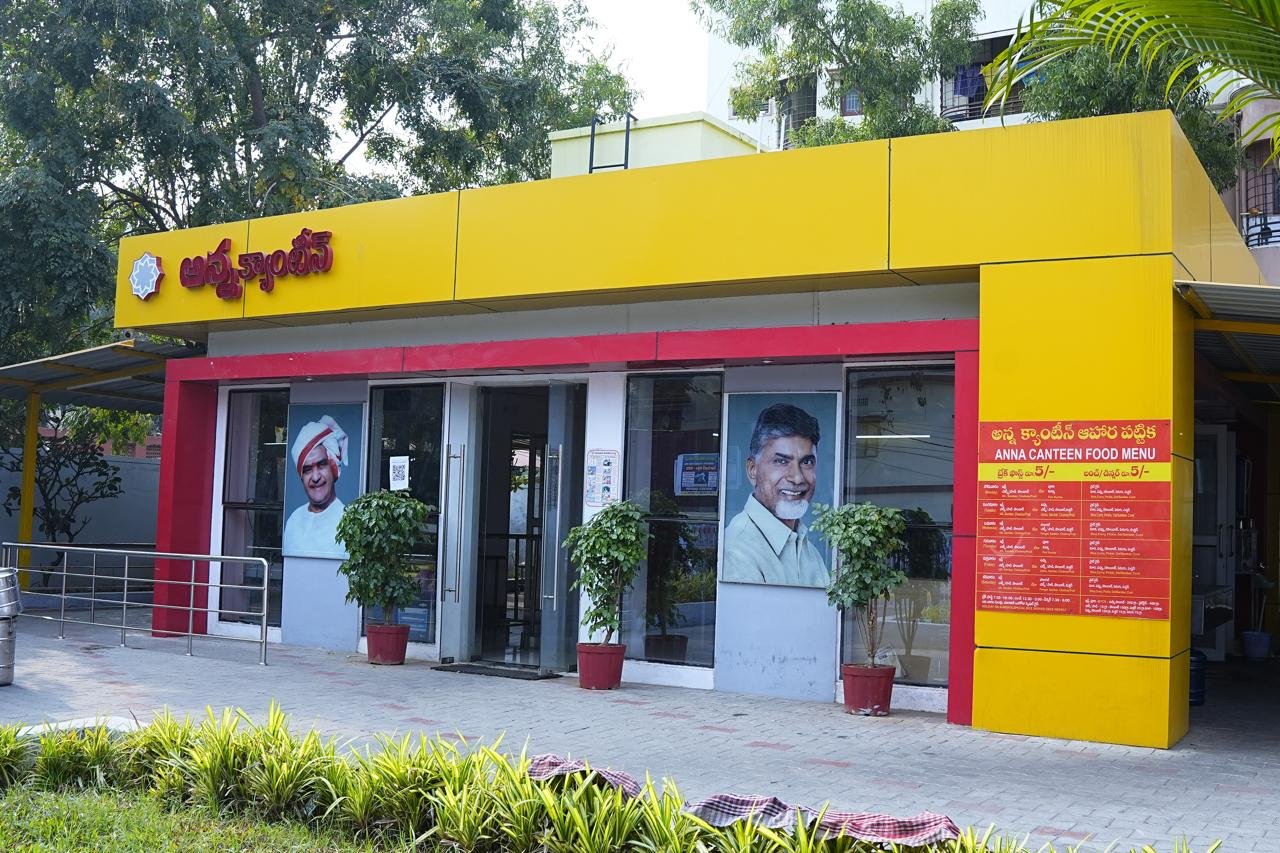
As in India’s Southern state of Andhra Pradesh, a large-scale public hunger-alleviation and food-security initiative is challenging conventional policy thinking. Anna Canteen serves more than 2.50 lakh subsidised meals daily across urban and rural geographies, and is now evolving into something more than just a “meal subsidy programme.” This transition is coming from a state-scale social infrastructure platform that understands the nature and nuance of the intersection between food security, dignity, public health, economic productivity, urban inclusion, rural outreach, and citizen participation at the population scale. As a result of this transition is a productive and more equitable society.
The Costs of Hunger
The global policy community often debates food subsidies in terms of fiscal prudence or just from a money point of view. But this ignores the deeper economic reality. Hunger doesn’t exist in a silo, and it imposes hidden costs on society: reduced labour productivity, higher public healthcare expenditure, lower educational attainment, reduced workforce stability, increased vulnerability, and social distress.
A daily wage worker who skips meals is not just undernourished; he or she becomes less productive, more vulnerable to illness, and less capable of upward mobility. Multiplied across millions, hunger becomes a drag on GDP itself. And to understand this should be intuitive.
In this context, subsidised meal programmes also go on to be solid investments in human capital with compounding socio-economic returns. This is where Anna Canteen becomes globally differentiated in philosophy.
Using a Public Utility Model for Food Security
Offering your most important stakeholders what they want is what makes the most difference. What makes a model like Anna Canteens’ unique, not just within India, but globally, even, is that they’re evolving into one of the world’s largest dignity-led public food security networks.
Most global hunger interventions are charity-driven and often city-specific, rolling out targeted relief mechanisms or emergency response systems. But the biggest issue is that the overall sentiment toward these initiatives isn’t as positive as you might think.
Anna Canteens are fundamentally different because they are institutionalised by the state, geographically distributed, permanently operational, and integrated into everyday economic life. ‘Integrated’ is the keyword here. This makes them more than just a temporary welfare handout. And though this may not matter initially to make an integrated system, at scale, this distinction becomes more important. Societies do not become stable merely through economic growth; human needs must be reliably secured while keeping in mind pragmatism and dignity, too.
Perhaps the World’s Largest Affordable Meal Programme
The reason such a model works is simple: Breakfast, lunch, and dinner are made accessible at as low as ₹5 (INR) or $0.05 (USD) per meal. But the true innovation doesn’t lie just in the pricing; it lies in the philosophy, as mentioned earlier. Unlike many global food subsidy systems, there is no exclusionary targeting architecture, no stigma-based certification, and no complicated eligibility gatekeeping. It is universal in the best essence of the word.
The underlying principle here is that if you are hungry, you deserve dignified access to food. In many ways, this resembles the philosophy of universal social infrastructure seen in Nordic welfare systems more than our traditional targeted subsidy frameworks associated with the Global South.
This is important because hunger does not always come with official poverty classifications. And that makes access difficult for groups such as urban migrants, informal workers, hospital attendants, sanitation workers, students, elderly citizens, and floating populations. They often fall through traditional welfare filters. To account for this, lived realities are made to be at the forefront of such execution.
Food Security leads to Economic Productivity.
Another important intellectual differentiation is that Anna Canteen’s position on food security is not just generic welfare or philanthropy; it’s a cog in the larger wheel as a productivity-enabling infrastructure.
Every affordable meal potentially translates into reduced worker vulnerability, lower daily survival costs, improved workforce productivity, greater economic participation, increased disposable income, safer migration ecosystems, and reduced urban distress. Isn’t it so immense what just having a full stomach can do for even one human? Not only does it cater to SDG 1, which aims for no poverty, but it also caters to SDG 2, which strives for zero hunger.
It enables economic participation. In rapidly urbanising economies, this matters because cities do not run on capital alone. They run on workers, whom we also have branded human capital. And if you catch all parts of that equation, productivity cannot happen without food security.
Urban-Rural Food Security
Globally, most subsidised food systems are concentrated in dense urban centres, shelters, or emergency zones. So what is now emerging in Andhra Pradesh is significantly more ambitious. The expansion of Anna Canteens across both urban and rural geographies is creating what can potentially be described as a distributed hunger-free state infrastructure.
This integrated continuum supports urban labour ecosystems, rural vulnerability reduction, migration resilience, and last-mile food access through one interconnected operational network. Very few governments globally operate food security systems at this scale with both urban and rural integration.
Dignity as a Core Design Principle
One of the programme’s most understated but powerful differentiators is dignity-centric system design. People do not stand in lines for “charity food” like a patronising reminder that you have to struggle visibly or participate in dependency optics to earn a nutritious meal.
People purchase tokens at an affordable price, eat in clean dining environments, receive hygienic meals, and participate in a shared public system with dignity. Anna Canteens normalise “shared public dignity.”
At an Anna Canteen, a migrant worker, an elderly citizen, a student, a policeman, a sanitation worker or any other person accesses the same service within the same public space.
Food Security to Public Health Infrastructure
Globally, healthcare conversations often focus downstream: on hospitals, insurance, medicines, and treatment systems. Anna Canteens, meanwhile, intervene upstream.
The programme’s contribution extends meaningfully into SDG 3 (good health and wellbeing). We’re talking about affordable access to hygienically cooked meals served at scheduled timings that directly contribute to improved nutritional regularity, reduced dependence on unsafe and often unhealthy street food, lower hunger-related stress, reduced health vulnerability, and improved mental well-being through food certainty and stability.
Public Access Infrastructure
The programme also aligns powerfully with SDG 10, which is for reducing inequalities. Here, a ₹5 meal does more than feed. It equalises access, makes you less worried about just survival and creates shared civic spaces across social divides. Importantly, inequality here is not addressed through abstract redistribution alone.
Participatory Welfare
Another unique evolution underway is the emergence of emotional and community ownership around the programme. Anna Canteens are increasingly becoming linked to special things. Like birthdays, anniversaries, memorial giving, “Gift A Meal” campaigns, donor participation, and local community sponsorship.
This creates what may be called participatory welfare, or, if you’d like to call it, more accessible and transparent philanthropy. Globally, very few systems combine state financing, nonprofit operational efficiency, community philanthropy, emotional giving, and citizen ownership all within one platform. But when that happens, and people begin contributing voluntarily to public systems, something important happens on a systemic level.
The P4 Model
While the traditional Public-Private Partnerships (PPPs) have transformed physical infrastructure across emerging economies, social infrastructure requires a broader governance architecture. Even though PPPs account for more than what could be done by private or public alone, there is still less space for people than has been necessary.
So what is now evolving is a Public-Private-People Partnership (P4) model. Here, governments provide legitimacy, scale, and accountability; nonprofits bring operational efficiency, and private actors contribute innovation and support. And citizens participate through ownership and giving. That is where long-term sustainability actually sees a good path forward.
Scale with Cost Efficiency is Rare
One of the most striking aspects of the programme is the combination of high utilisation, visible citizen impact, operational continuity, and fiscal efficiency. At over 2.5 lakh meals per day, the programme delivers massive social impact at relatively modest public expenditure.
Robust Global Relevance
As countries across Asia, Africa, and Latin America grapple with urbanisation, inequality, and rising economic vulnerability, the need for scalable social infrastructure models is becoming urgent. The Andhra Pradesh model offers an important insight: development cannot be measured only through GDP growth, infrastructure projects, or digital transformation. It must also be measured by whether ordinary citizens can access the fundamentals of human dignity via a human-centred infrastructure at the population scale, which addresses SDG 11 (sustainable cities and communities).
In my own journey across countries, from corporate boardrooms to nonprofit ecosystems, and now into public systems, one insight has remained constant: People do not experience policy and remember it. They experience dignity, respect, positive sentiment or the lack of it. Every day at an Anna Canteen, what appears outwardly as a ₹5 meal is, in reality, something much deeper. A construction worker beginning his day with certainty, a migrant choosing stability over distress, an elderly citizen eating with dignity, a family holding on to hope rather than merely survival.
As N. Chandrababu Naidu has often emphasised in his vision for a Swarna Andhra Pradesh, development must ultimately be measured by whether it reaches the last person and improves the quality of everyday life. When public systems deliver with dignity, people do not merely consume them. They believe in them. They participate in them. And eventually, help sustain them, leading to a natural and integrated P4 Model approach.
That is when a programme becomes an institution and governance becomes a partnership. And food security reveals itself as the basis for a more equitable, productive, and humane society.
“Governments alone cannot eliminate hunger. Through programmes driven by P4 (Public-Private-People Partnership), platforms like Anna Canteen become a people’s movement where society participates in ensuring that no one sleeps hungry.”
About Vamsidhar:
Vamsidhar Pothula is an institution builder and public systems leader with extensive experience across corporates, government, nonprofit, and development sectors in emerging markets. He specialises in operational transformation, ecosystem partnerships, and scaling high-impact social initiatives at the intersection of governance, sustainability, and technology. Currently serving as the CEO of Anna Canteen, Govt. of Andhra Pradesh (India), where he leads a flagship public welfare program focused on food security, hunger alleviation, inclusion, and systems strengthening.