
For decades, building a business has followed a familiar formula. Entrepreneurs hire employees, invest in software tools, and gradually construct systems to run operations like marketing, customer support, data management, and sales. But a quiet shift is starting to emerge in the digital economy—one where businesses may no longer need to build everything themselves.
Instead, they might simply buy the systems they need.
A new generation of platforms is beginning to treat automation as a marketplace product, allowing companies to discover, purchase, and deploy ready-made automated workflows and AI-powered systems. Much like how app stores transformed the software industry, automation marketplaces could reshape how companies operate in the coming decade.
At the center of this idea is a simple question:
What if businesses could instantly deploy operational systems instead of building them from scratch?
Traditionally, automations and AI systems require developers, integration specialists, and weeks—sometimes months—of configuration. For many small businesses and startups, this complexity creates a barrier. The technology exists, but accessing it is difficult.
Automation marketplaces aim to remove that friction.
Rather than hiring a developer to build a custom automation, a company could simply browse a library of pre-built systems designed to perform specific tasks. These could range from marketing automations and lead-generation workflows to AI-powered customer support agents and data analysis pipelines.
The idea mirrors what happened when software moved to app stores. Before the rise of mobile platforms, software often required installation, configuration, and technical expertise. App marketplaces simplified the experience dramatically: users could simply search, click, and deploy.
Automation marketplaces attempt to do the same for business infrastructure.
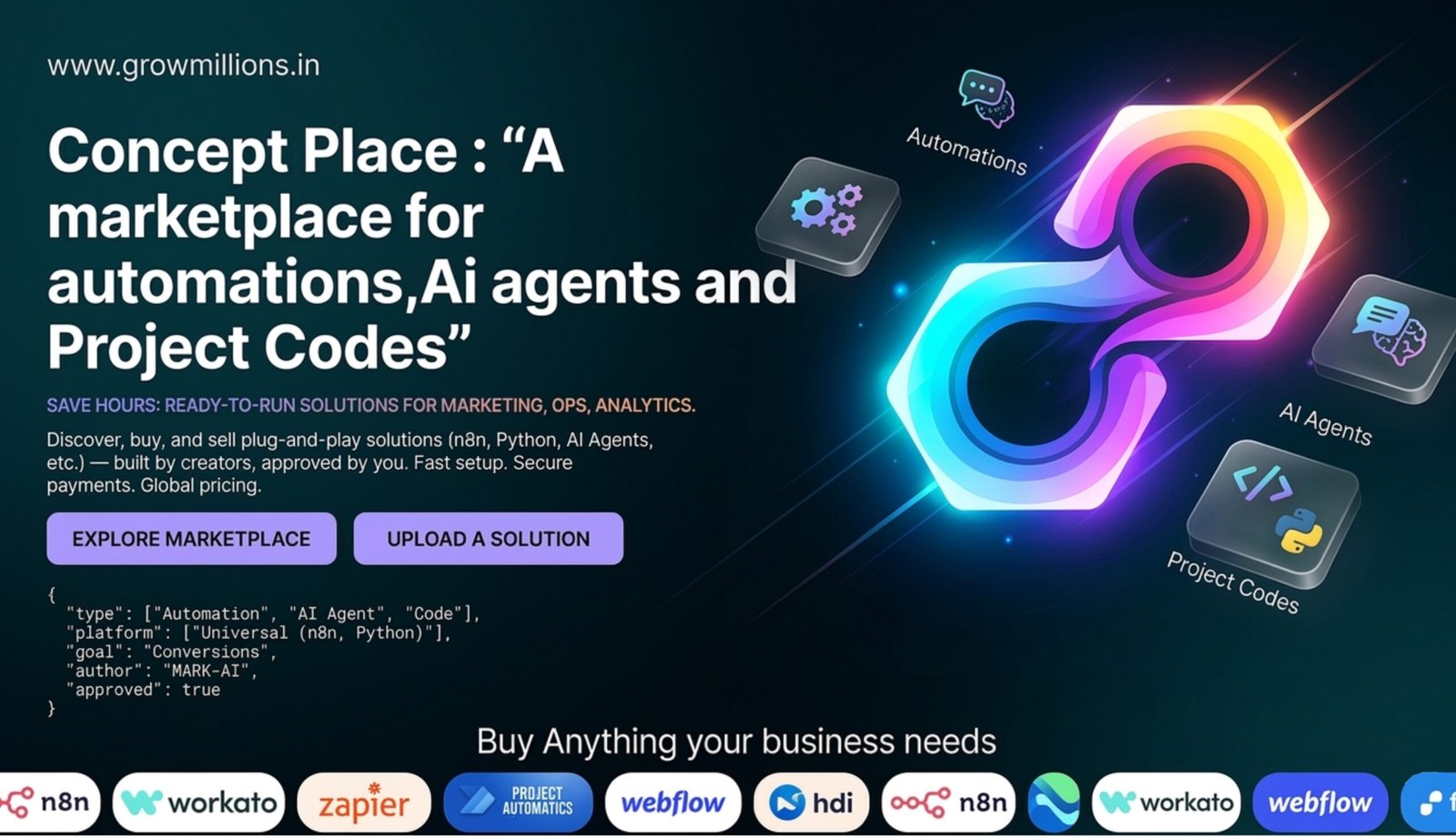
One platform exploring this model is ConceptPlace, developed by the AI-focused company Grow Millions. The platform is designed as a centralized marketplace where businesses can discover and deploy automation systems and AI agents built by creators, developers, and automation specialists.
Instead of assembling complex systems internally, companies can access ready-made solutions that are designed to plug directly into their workflows.
The broader vision behind this model extends beyond convenience. It points toward a future where business infrastructure becomes modular.
In that world, launching a company may look very different from today. Entrepreneurs might not start by hiring teams or building large technical systems. Instead, they could assemble a “stack” of operational automations—deploying marketing agents, sales pipelines, customer support systems, and operational dashboards from a marketplace.
This shift could dramatically lower the barriers to entrepreneurship.
A solo founder could operate with capabilities that previously required entire departments. Small businesses could scale faster by deploying proven automation systems instead of experimenting with costly internal development.
At the same time, automation marketplaces may create a new type of digital economy.
Just as the rise of app stores produced a global community of developers building software products, automation marketplaces could give rise to automation creators—individuals and teams who design specialized business workflows and AI agents that others can purchase and deploy.
In this ecosystem, automation itself becomes a product.
Of course, the model is still in its early stages. Businesses will need reliable standards, strong integrations, and trust in the systems they deploy. But if the concept gains traction, it could reshape how companies structure operations in the years ahead.
Prototype is ready and present in the market: www.growmillions.in
Instead of building systems piece by piece, the next generation of businesses might simply assemble them from a marketplace.
And if that shift happens, the way companies are built—from startups to large organizations—could change in ways that are only beginning to be imagined.