
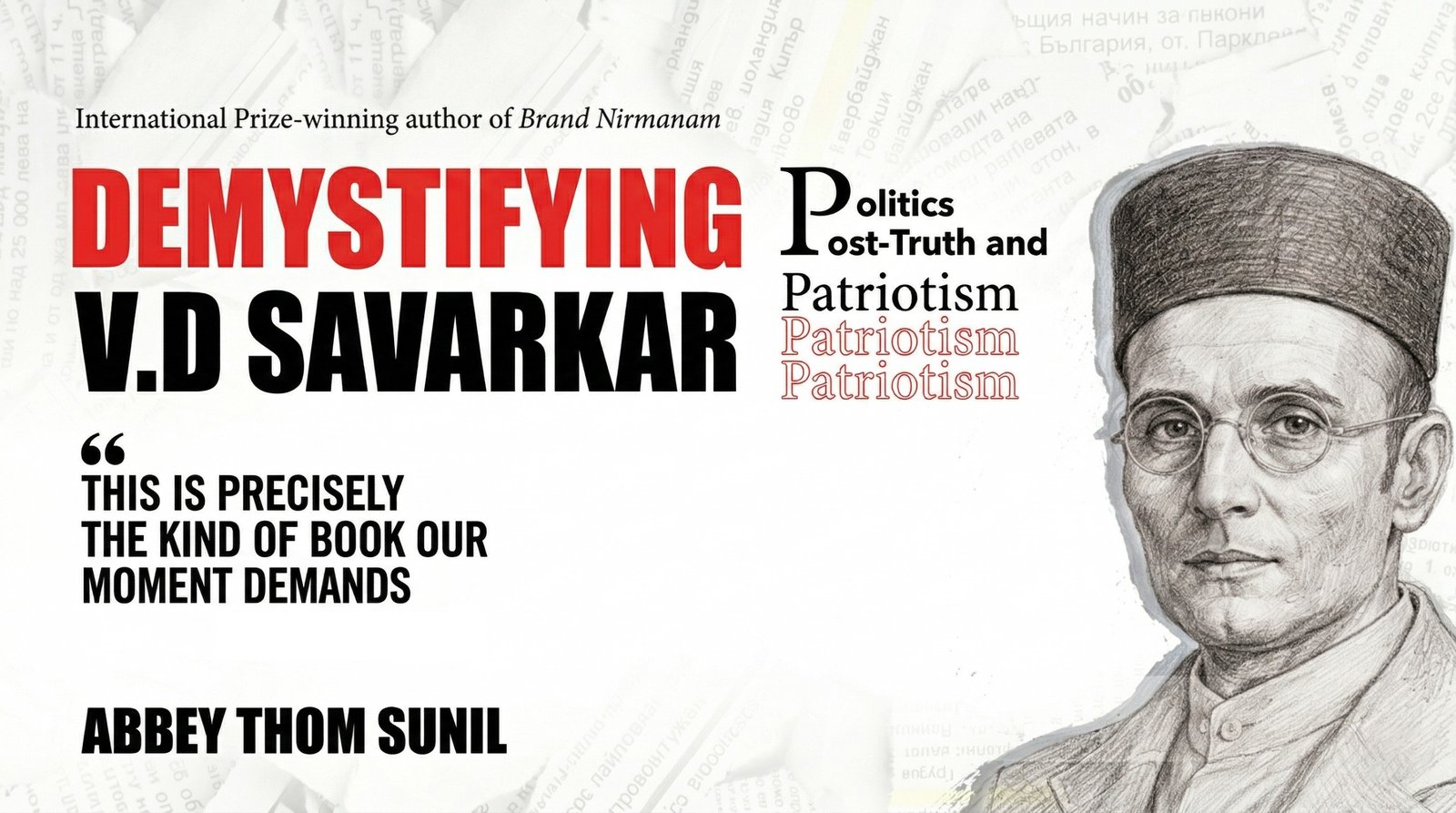
In an intellectual climate where taking nuanced positions on controversial subjects invites attacks from all sides, Abbey Thom Sunil’s decision to write a comprehensive, evidence-based study of V D Savarkar represents an act of scholarly courage. “Demystifying V D Savarkar: Politics, Post Truth and Patriotism” promises to be the definitive work on its subject—not because it settles all debates, but because it establishes the factual terrain upon which informed debate can occur.
The genius of Sunil’s approach lies in his refusal to participate in the culture war surrounding Savarkar’s legacy. He does not write as an apologist seeking to redeem a tarnished reputation, nor as a prosecutor building a case for historical condemnation. Instead, he writes as a historian committed to understanding a complex figure within the multiple contexts that shaped him: colonial India, Hindu-Muslim relations, revolutionary movements, the independence struggle, and post-independence politics.
This commitment to contextual understanding without moral relativism represents the gold standard of historical scholarship. Sunil demonstrates that we can understand why historical figures believed and acted as they did without endorsing those beliefs or actions. We can recognize the genuine grievances and aspirations that motivated Savarkar while critiquing the solutions he proposed. We can acknowledge his intellectual influence while questioning whether that influence has been salutary.
The book’s engagement with contemporary “post-truth” politics is particularly valuable. Savarkar has become a Rorschach test—different groups project their own values and agendas onto his legacy, often with scant regard for historical accuracy. Some claim he advocated for gender equality and social reform; others insist he championed an exclusionary, authoritarian vision of the nation-state. Sunil’s meticulous research will finally allow readers to distinguish between evidence-based claims and convenient fabrications.
What makes this work essential reading extends beyond its specific subject matter. In method and approach, “Demystifying V D Savarkar” models how to think critically about controversial topics. It demonstrates how to evaluate competing claims, how to weigh evidence, how to acknowledge complexity while maintaining analytical clarity. These skills are increasingly rare and increasingly necessary in our fragmented information environment.
The book will undoubtedly generate controversy. Those who have built careers or political movements
on particular readings of Savarkar may find their narratives challenged. But honest controversy—debate grounded in evidence and conducted in good faith—is precisely what healthy democracies require. By providing a rigorous, documented account of Savarkar’s life and thought, Sunil creates the foundation for such honest disagreement.
For readers seeking to understand how India arrived at its current political moment, for scholars studying nationalism and identity politics, for citizens trying to navigate competing historical narratives, “Demystifying V D Savarkar” will prove indispensable. Abbey Thom Sunil has performed a signal service to scholarship and to public discourse—he has insisted that facts matter, that evidence matters, and that intellectual integrity matters, even when discussing our most divisive subjects.