
By Karthik Parashar, Founder — Glaciers Studio.
AI video tools have never been more powerful. Google Veo, Runway Gen-4, Kling, Sora, Hailuo — the models are producing frames that rival professional B-roll. Yet for every filmmaker, agency, and brand team trying to build something real with them, the frustration is identical: you can get one stunning shot, but you can’t control what comes next.
That is the exact problem Nirmiit was built to solve — not by replacing AI video models, but by giving creators the structured, pre-production layer those models were always missing.
The Real Problem in AI Video Production
The AI video generation market is growing fast. It is projected to scale from $3.67 billion in 2026 to $24.89 billion by 2036, at a compound annual growth rate of 21.4%. Adoption is accelerating across filmmaking, advertising, social content, and brand campaigns. And yet, despite the rapid advancement of the underlying models, one problem persists across all of them: prompt inconsistency.
Ask any creator who has spent real production time with these tools. What makes Runway deliver something cinematic will generate visual chaos in Kling from the same input. Characters shift between scenes. Environments morph. Lighting tone drifts between shots. Even the most carefully crafted text prompt reinterprets itself differently each time the model runs.
The reason is fundamental: standard text-to-video models operate on a best-guess basis. They do not understand narrative continuity, production intent, or visual identity. They sample training data and produce a plausible result — which is a different thing entirely from producing the right result for a specific creative vision. Switching models does not fix it. Writing more detailed prompts rarely fixes it. The industry has spent years teaching creators to write better prompts, and the results have been predictably inconsistent: technically sharp individual frames stitched into projects with no coherent film identity.
Nirmiit reframes the problem entirely. Prompts are not the product. Blueprints are.
What Nirmiit Actually Is
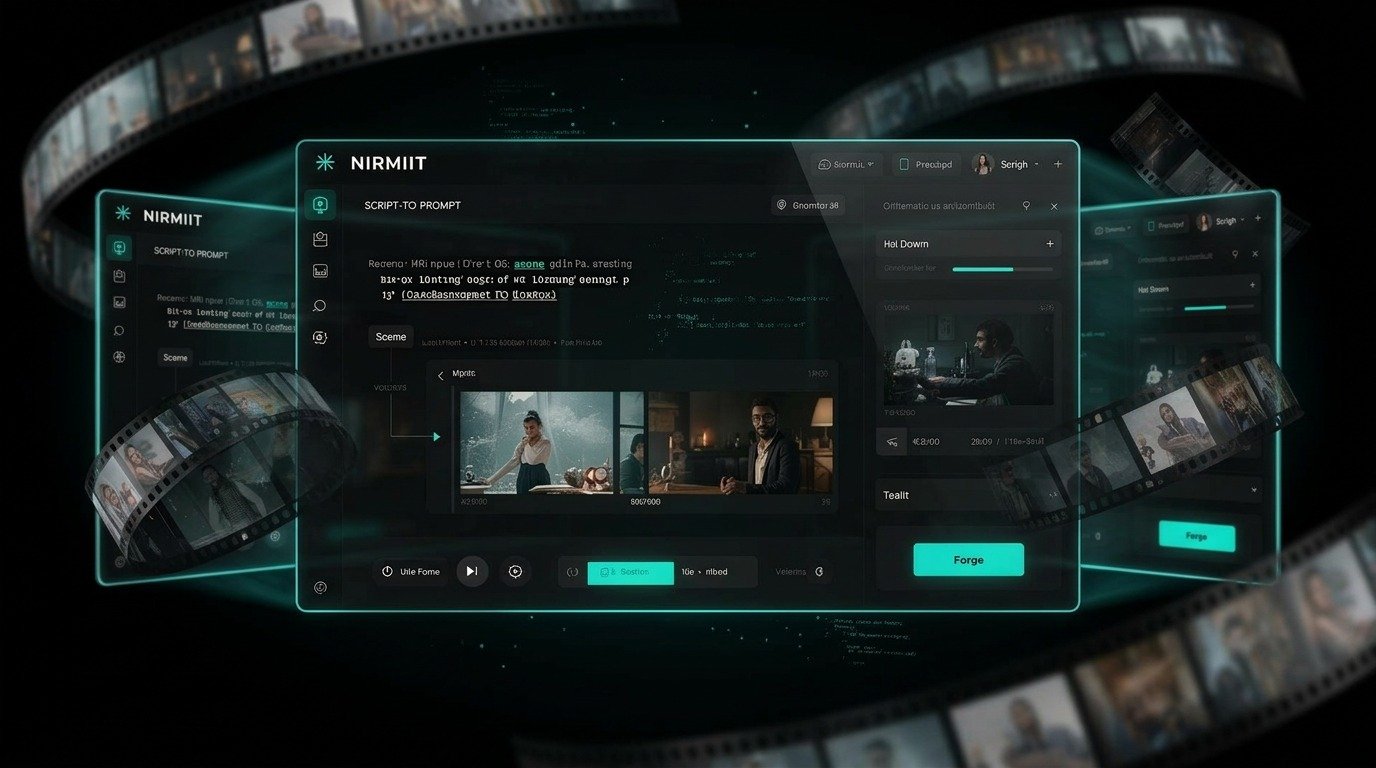
Nirmiit is a script-first AI production engine — a cinematic prompt and workflow platform that converts raw scripts, ad briefs, brand narratives, and concepts into structured, model-ready Production Blueprints.
Think of the difference between emailing a film crew vague verbal directions versus handing them a proper call sheet. One leaves everything to interpretation. The other runs like a machine. Nirmiit brings that same discipline to AI video — without requiring a producer, a DOP, or a dedicated prompt engineer.
It works with all the major AI video models: Veo, Kling, Runway Gen-4, Sora, Hailuo, and Luma Dream Machine. Crucially, it does not lock creators into any single platform. The blueprint is the constant; the model becomes a variable.
Inside the Forge Studio
The core workspace is called the Forge Studio. Paste anything into it — a proper screenplay, a rough ad brief, a brand story, or a single paragraph describing a scene — and Nirmiit processes the creative intent into structured production layers.
This is not a black box. The structure is visible, editable, and entirely owned by the creator. The Forge Studio pulls out the scene intent, mood, character action, location logic, and narrative pacing from any input format, then organizes it into a layered manifest that any supported AI video engine can interpret. Instead of guessing how to communicate with the model, the creator focuses on the story — and the platform handles the translation.
The result feels less like using a tool and more like having a virtual production assistant that already understands how filmmakers think.
Production DNA: Consistency at Scale
The most important innovation inside Nirmiit is the Production DNA panel. This is where serious creators earn back control.
Before generating a single frame, creators set the visual and tonal identity of the entire project: lens profile, camera rig type, aspect ratio, color grade tone, pacing rhythm, and brand voice. Once defined, these parameters propagate through every shot and every prompt in the blueprint automatically. Change the lens profile once — every prompt in the project updates accordingly.
This solves the single most damaging issue in multi-scene AI video production: style drift. The character who looks slightly different in scene five. The color temperature that shifts between shots eleven and twelve. The camera logic that feels like a different film by the third act. Production DNA eliminates all of it before generation begins, because consistency is baked into the structure — not bolted on afterward through manual prompt rewriting.
For agencies managing multiple ad variations or brands maintaining a unified visual identity across campaigns, this single feature changes the economics of AI video entirely.
A Model-Agnostic Architecture
One of Nirmiit’s most strategically important decisions is what it chose not to do: it does not pick a model for creators, and it does not trap them in one.
The AI video landscape is changing every few months. Kling 3.0, Veo updates, Runway Gen-4.5 — each new release shifts what is optimal for a specific type of scene or style. A production built on a single-platform tool becomes obsolete or requires complete rebuilding when the underlying model changes.
Nirmiit’s model-agnostic architecture means the same blueprint exports optimized manifests for whichever engine the creator is currently running. The creative direction stays constant; the generation layer is interchangeable. This is a genuinely future-proof architecture in an industry moving at this pace.
Privacy-First, Enterprise-Ready
For agencies and brands with IP sensitivity, Nirmiit’s approach to data is not just a feature — it is a requirement.
Nirmiit operates with bring-your-own-API-key access for providers including OpenAI and Gemini. Client scripts, brand briefs, unreleased concepts, and campaign assets are not ingested or stored on Nirmiit’s servers. In an environment where AI tool IP leakage is an active concern for production teams and legal departments, this matters. The blueprint system creates an auditable, structured workflow that creative directors and compliance teams can actually sign off on.
For enterprises running AI-generated campaign content at scale, that sign-off is not a small thing.
Who It Is Built For
Nirmiit is a precision instrument, not a general-purpose tool. It serves four distinct professional use cases:
- Indie directors and cinematographers — describe shots in the language of filmmaking; Nirmiit translates to model-ready instructions without requiring prompt engineering expertise
- Content creators and series producers — build full episode blueprints in a single session, with framing, pacing, and style locked globally across every scene
- Creative agencies — run 20 ad variations off a single Production DNA setup without rebuilding the brief for every deliverable or market
- Brands and marketing teams — preserve visual identity, palette, character continuity, and brand voice across all AI-generated assets, so every output looks like it was directed by the same person
The distinction matters. Nirmiit does not try to be an all-in-one video editor or a casual chatbot for generating clips. It is the structured pre-production infrastructure that determines whether the generation phase produces something that actually looks designed.
Why “Prompt Engineering” Was Never the Right Frame
The AI creative space has spent two years focused on prompt engineering — teaching non-technical people to write better text inputs. The results speak for themselves: technically competent individual shots that rarely cohere into finished work with a distinct visual identity.
The creators producing the most convincing AI video are not thinking like prompt engineers. They are thinking like directors — working with consistent identities, stable environments, and intentional camera logic rather than rewriting prompts shot by shot.
Nirmiit operationalizes that mindset. Pre-production does not constrain creativity. It amplifies it, because every decision made in the blueprint phase saves ten decisions — and ten regeneration cycles — at the generation stage. The platform brings the discipline of proper film pre-production to AI video without requiring the headcount that pre-production usually demands.
Free to Start. Built for Serious Work.
Nirmiit is free to start, and unlike most free-tier AI tools, the core capabilities are not artificially limited. The Forge Studio, Production DNA panel, and blueprint export system are all accessible from day one. Creators bring their own API keys; Nirmiit brings the production intelligence.
It is positioned explicitly for serious creators over casual users — and that positioning is intentional. The AI video generation market is moving toward professional-grade workflows. Creators who build structured, repeatable production systems now will set the pace as the line between creative and technical continues to close.
Nirmiit is the tool that makes that structure possible.
Nirmiit is live at nirmiit.in — free to start, built for production.
References
- AI Video Generators in 2026: 10 Tools Tested, Compared & Ranked … – The global AI video generator market was valued at $788.5 million in 2025, and according to Grand Vi…
- Top AI Video Generation Tools in 2026 for Creators, … – Top AI Video Generation Tools to Know in 2026 (Features, Unique Strengths, and Pricing) · 1) Google …
- AI Video Generation & Editing Software Market – AI video generation & editing software market is expected to grow from USD 3.67 billion in 2026 to U…
- The Complete AI Video Prompt Ultimate Guide 2025 – DomoAI – I’m going to walk you through my entire journey—the breakthroughs, the face-palm moments, and most i…
- How Reference-to-Video AI Solves the Consistency Problem – Reference-to-video AI helps creators maintain character consistency and cinematic storytelling acros…
- Top 5 AI Video Generator Problems Creators Face and … – Higgsfield – Visual Instability and Frame Inconsistency. Even advanced AI video generators can struggle to mainta…
- Why AI Videos Feel Fake—and How Consistency Changes Everything – A stylized AI video with perfect internal consistency can feel more convincing than a photorealistic…
- Why AI Content Still Fails in 2026 Despite Smarter Models – ShortVids – When prompts lack clarity, structure, or boundaries, AI fills the gaps with safe assumptions. The br…
- Nirmiit – AI Prompt Studio for Filmmakers & Creators – Turn raw scripts into production-ready AI video prompts. Nirmiit is the cinematic control panel for …
- Nirmiit (@Nirmiit_ai) / Posts / X – AI Control Panel Built for filmmakers & creators. Turn raw scripts into production‑ready AI video pr…
- nirmiit-article-1.html – ## The problem with AI video right now
Ask any filmmaker who has spent real time with Veo 3, Runway…
- AI Video Model Release Tracker (2026) – Magic Hour – Track the latest AI video model releases in 2026, including Seedance 2.0, Kling 3.0, Veo, Sora, and …
- Subtle Inconsistencies: Filmmakers and Generative AI in 2024 – Although less common, some films are using AI tools not to change production methods but to modify c…
- Jayme Baggio’s Post – Ai Filmmaking Blueprint 2.0 – I’m continually finding you can’t treat any AI workflow as static! It’s been less than a month since…
- Artificial Intelligence (AI) Video Generator Market Report … – The Artificial Intelligence (AI) Video Generator market was valued at $0.85 billion in 2025, increas…